Harvesting food and energy for a more resilient nation.
Midwest Agrivoltaics for Resilient Communities (MARC) is a regional weather resilience incubator funded in 2025 by the National Science Foundation. MARC is based at Purdue University, with support from the Purdue Institute for a Sustainable Future.
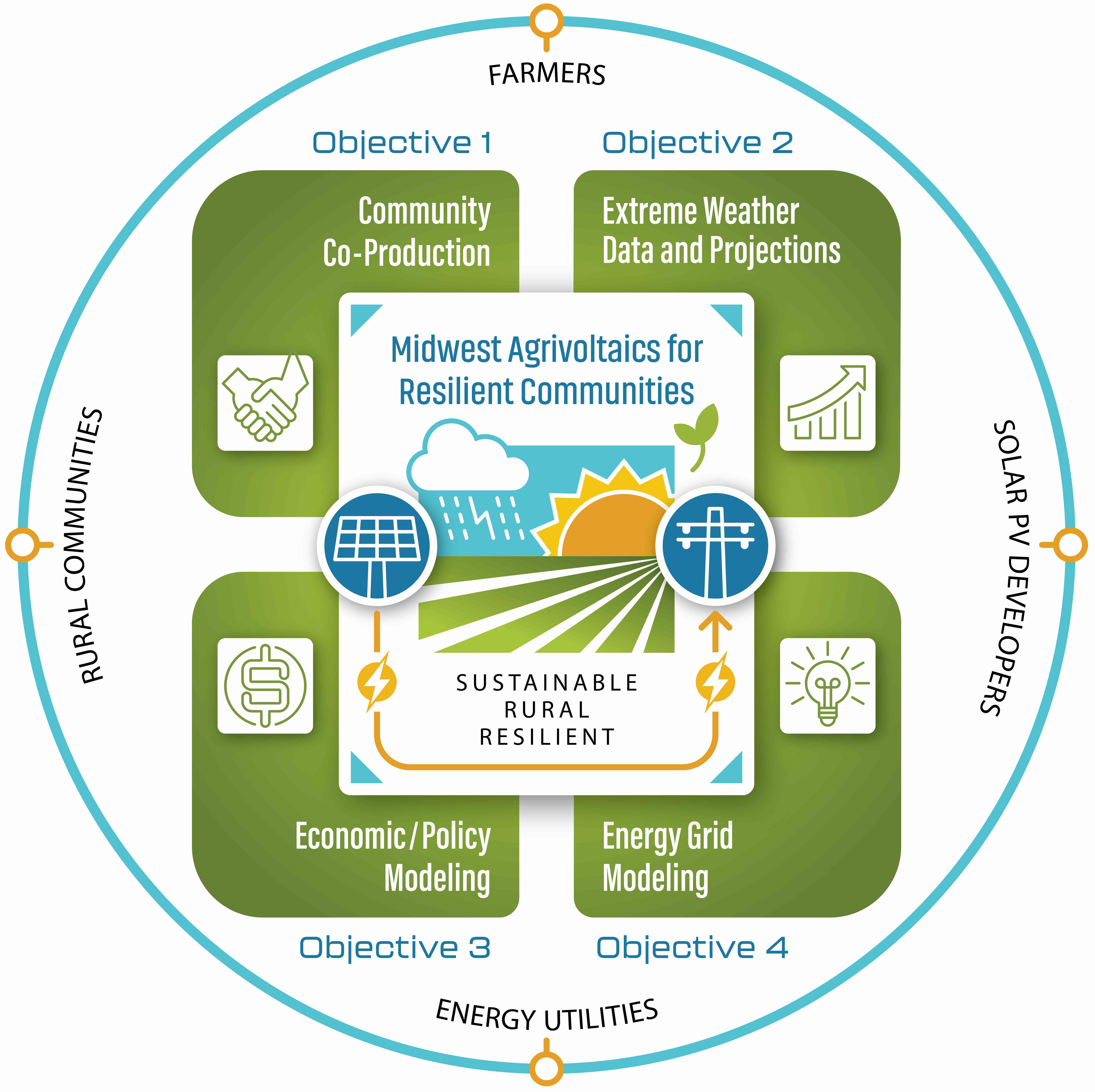
MARC is focused on the transformative potential of agrivoltaics – harvesting food and energy on the same land – to enhance the economic resilience and power security of rural Midwestern communities in the face of severe weather. Producing both food and energy locally can help diversify and stabilize landowner income, reduce power outages, and ultimately create a more prosperous rural Midwest. But agrivoltaics are new and stakeholders face many challenges and uncertainties. Overcoming these obstacles requires trust and objective information. MARC aims to fill this gap by bringing together community, agriculture, and energy partners and serve as a source of trusted information for supporting agrivoltaics decision-making.
We are focused on the following questions:
- Can agrivoltaics boost local and regional economic resilience to extreme weather?
- Can solar microgrids increase power security and reduce weather-induced outages?
- What types of agrivoltaic systems are most suitable in different regions?
- Can all of the above make solar more acceptable to local communities?
To tackle these questions, MARC is developing infrastructure to quantify the potential resilience benefits of agrivoltaics for the local/regional economy and of solar microgrids for local power security; evaluate the suitability of agrivoltaics pathways across agricultural, energy, and social dimensions; and work directly with stakeholders to foster dialogue, build trust, and identify community-centered solutions.
Activities
- 2026 Indiana Land Use and Agrivoltaics Summit. MARC co-hosted a statewide Summit on August 27, 2026 at the Beck Agricultural Center in West Lafayette, IN, convening nearly 90 participants from more than 40 organizations — farmers and landowners, local officials, solar developers, utilities and rural electric cooperatives, agricultural organizations, and researchers — for a full day of presentations and facilitated breakout discussions on land use and agrivoltaics in Indiana. Summit lead: Dr. Kara Salazar (salazark@purdue.edu).
- Community focus groups. Structured focus groups with Indiana stakeholders on solar siting, land use concerns, and what information communities need to evaluate agrivoltaics. Results were presented back to participants and to the broader audience at the Summit.
- Statewide survey. A survey of Indiana residents and landowners is planned for fall 2026, building on themes surfaced in the focus groups and at the Summit.
- Extreme weather trends database. We are building a public, county-resolution database and interactive visualization of long-term U.S. extreme weather trends — hail, tornadoes, thunderstorm wind, freezing rain, peak wind, and precipitation — to give communities a common factual basis for understanding their local weather risk. Public release is planned; details to follow.
- Farm-scale economic resilience modeling. Modeling how dual-use solar affects farm income variability and economic resilience to weather extremes, at the farm and regional scale.
- Rural microgrid and energy resilience modeling. Multi-layer modeling of rural distribution systems and solar microgrids to quantify their potential to reduce weather-induced power outages.
- Industry, utility, and agricultural partnerships. Ongoing engagement and data-sharing collaborations with solar developers, investor-owned utilities, rural electric cooperatives, farmland management and agricultural finance organizations, and conservation groups across Indiana and the Midwest.
- Indiana Sustainability and Resilience Conference panel. The full MARC leadership team presented a joint panel — "Midwest Agrivoltaics Incubator: Increasing Resilience and Prosperity in the Midwest" — at the 2026 Indiana Sustainability and Resilience Conference, hosted by the Indiana University Environmental Resilience Institute, spanning the project's weather, economic, agricultural, and energy dimensions and gathering feedback from sustainability professionals, business leaders, and elected officials from across the state.
- Advisory Board. MARC convened its first Advisory Board meeting in January 2026 and will hold a second, partner-driven working meeting on Purdue's campus in fall 2026.
- Research dissemination. MARC results will be presented at the American Geophysical Union Fall Meeting (December 2026) and the American Meteorological Society Annual Meeting (January 2027).
MARC is a non-advocacy project. Our role is to provide objective information to help communities, key stakeholders, and decision-makers navigating the rapidly-evolving agrivoltaics landscape.
Leadership Team
Department of Earth, Atmospheric, and Planetary Sciences
Department of Horticulture and Landscape Architecture
Purdue Extension Community Development, Illinois-Indiana Sea Grant, Department of Forestry and Natural Resources
School of Engineering Technology, Elmore Family School of Electrical and Computer Engineering
Partners & Collaborators
Internal Partners
- Tamara Ogle - Purdue Extension Community Development
- Darrin Karcher - Livestock
- Petrus Langenhoven - Specialty Crops
- Kevin Kircher, Andrew Liu, Siva Seetharaman - Energy Microgrid
- Rakesh Agrawal, Peter Bermel, Mitch Tuinstra - Agrivoltaics Technology
- Matt Huber - Climate/Weather
- Melissa Widhalm - Midwest Regional Climate Center
- Purdue Institute for a Sustainable Future
External Partners
- Victor Gensini (Northern Illinois University, Center for Interdisciplinary Research on Convective Storms)
- Tipmont REMC
- NiSource / NIPSCO
- National Rural Electric Cooperative Association
- DORAL Renewables
- Bechtel
- CN Consulting LLC
- Wabash Heartland Innovation Network
- Halderman Real Estate & Farm Management
- Farm Credit Illinois
- The Nature Conservancy – Indiana
- Farm-to-Power